
Back to Blog
How Expatriate Students Can Learn Arabic Easily
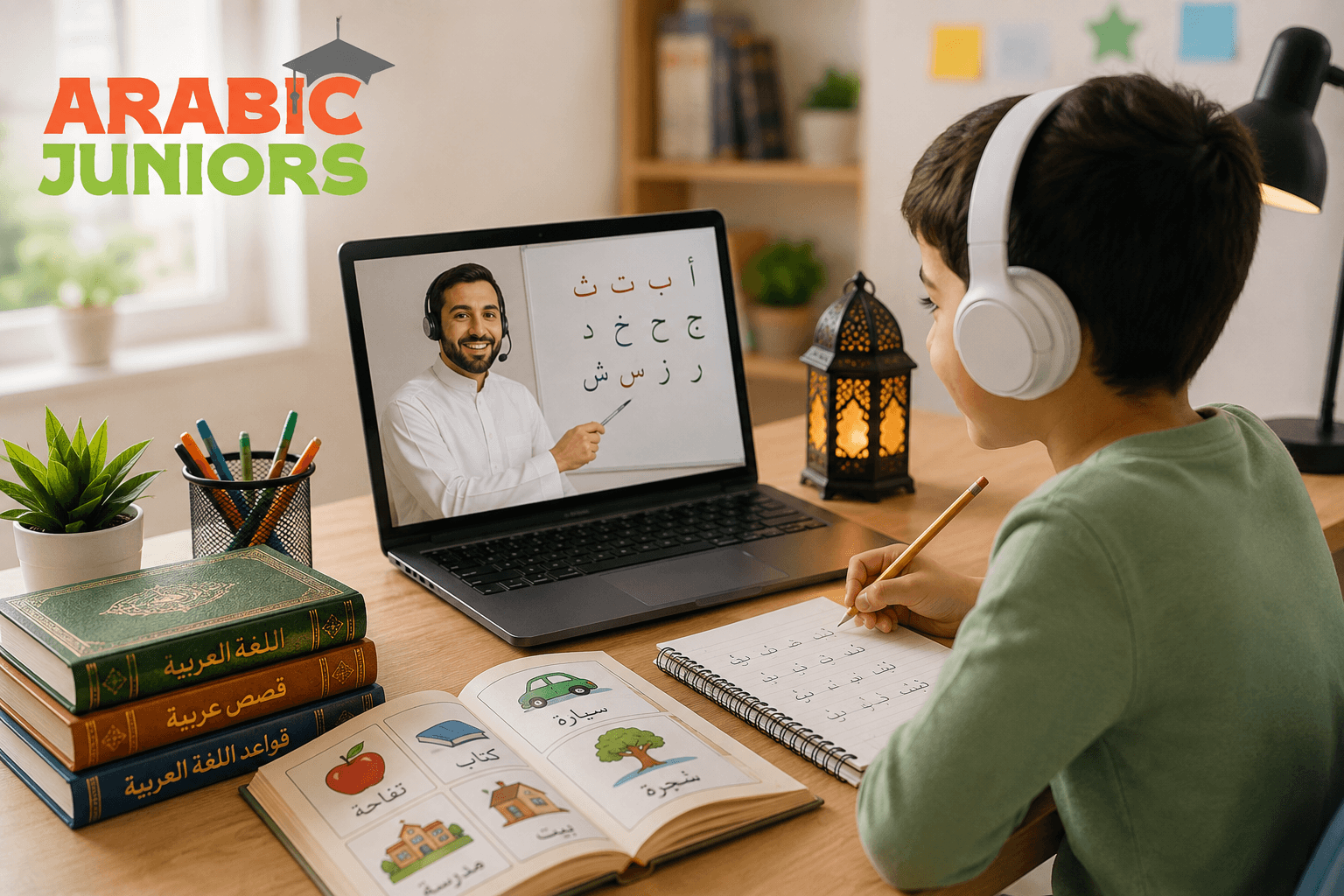
Moving to a new country is an exciting experience, but it can also bring new challenges—especially when it comes to language.
For expatriate students living in the UAE, Arabic can be both a school subject and an important part of everyday life. Students may encounter Arabic at school, in public places, during cultural activities, and while interacting with Arabic-speaking communities.
For students who did not grow up speaking Arabic, the language can initially feel difficult because of its alphabet, pronunciation, vocabulary, grammar, and sentence structure.
The good news is that learning Arabic as an expatriate student does not have to be difficult.
With the right learning strategy, regular practice, and guidance from a qualified Arabic teacher, students can gradually improve their Arabic speaking, reading, writing, listening, vocabulary, and grammar skills.
Arabic Juniors provides online Arabic tuition for students across the UAE, supporting different school systems including MOE, CBSE, British, IB, and American curricula.
In this guide, we'll explore practical ways expatriate students can learn Arabic easily and confidently.
Why Should Expatriate Students Learn Arabic?
Arabic is more than a school subject for students living in the UAE.
Learning Arabic can help students:
Communicate more confidently
Understand their surroundings
Perform better in Arabic classes
Improve reading and writing
Build vocabulary
Communicate with Arabic-speaking classmates
Understand local culture
Feel more comfortable in everyday situations
Prepare for Arabic exams
Develop an important international language skill
Arabic Juniors also highlights the importance of Arabic for students' academic success, communication, cultural understanding, and future opportunities.
1. Start With Basic Arabic Vocabulary
One of the easiest ways to start learning Arabic is to focus on words that you encounter every day.
Don't begin by trying to memorize hundreds of complicated words.
Instead, learn vocabulary related to your daily life.
Start With These Topics:
Greetings
مرحبا – Marhaban – Hello
شكرا – Shukran – Thank you
صباح الخير – Sabah Al-Khair – Good morning
مع السلامة – Ma'a Al-Salama – Goodbye
Family
أب – Ab – Father
أم – Umm – Mother
أخ – Akh – Brother
أخت – Ukht – Sister
School
مدرسة – Madrasa – School
كتاب – Kitab – Book
قلم – Qalam – Pen
معلم – Mu'allim – Teacher
طالب – Talib – Student
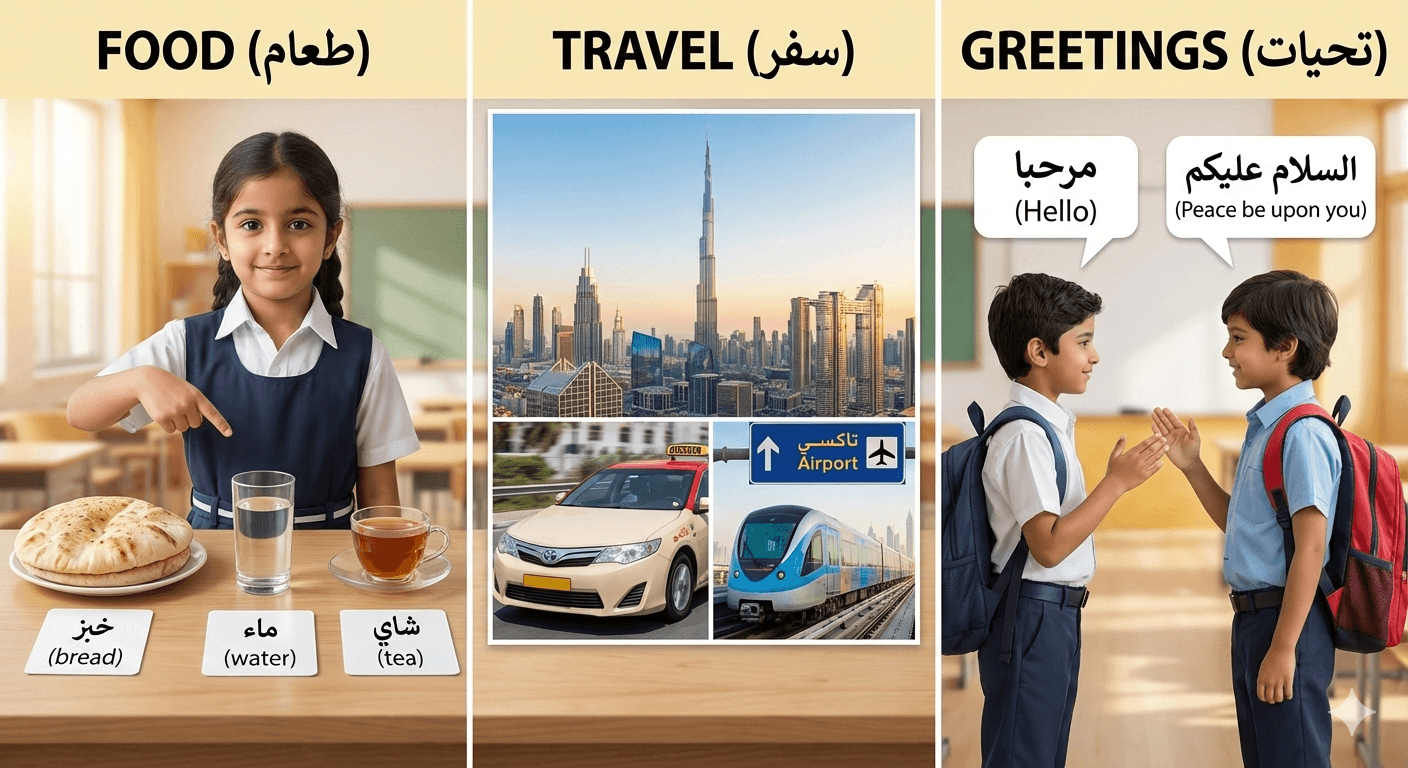
Learning vocabulary based on real-life themes makes Arabic more practical and easier to remember. Arabic Juniors similarly recommends learning words by themes such as food, travel, and greetings for learners in the UAE.
2. Learn Arabic Through Daily Situations
Instead of learning Arabic only from textbooks, connect new words with things you actually see and do.
For example, when you visit a supermarket, try to identify Arabic words on signs and products.
When travelling, look for Arabic words related to:
Roads
Directions
Transportation
Airports
Shops
Restaurants
When you're at school, learn words related to:
Classroom
Homework
Exams
Subjects
Teachers
Friends
This technique helps transform Arabic from a school subject into a language you use in real life.
3. Focus on Speaking Arabic Every Day
Many students can understand Arabic but hesitate when they need to speak.
The solution is simple:
Speak a little Arabic every day.
You don't need to have long conversations.
Start with simple sentences:
أنا طالب – I am a student.
أنا أحب القراءة – I like reading.
أين المدرسة؟ – Where is the school?
أريد ماء – I want water.
كيف حالك؟ – How are you?
Make mistakes without being afraid.
Speaking regularly helps improve confidence and makes vocabulary easier to recall.
4. Learn Arabic Through Short Conversations
Instead of memorizing individual words, learn complete phrases.
For example, don't only memorize:
كتاب = Book
Learn:
هذا كتاب. = This is a book.
Similarly:
مدرسة = School
becomes:
أنا ذاهب إلى المدرسة. = I am going to school.
Learning words in context helps students understand how Arabic vocabulary works within sentences.
5. Build a Strong Arabic Reading Foundation
Arabic reading can be challenging for non-native speakers because the writing system is different from English and many other languages.
Start by mastering:
Arabic alphabet
Letter sounds
Short vowels
Long vowels
Connected letters
Word formation
Simple sentences
Students should avoid rushing into complicated passages before becoming comfortable with basic Arabic letters and sounds.
Regular reading practice can gradually improve pronunciation, vocabulary, comprehension, and confidence.
6. Practice Arabic Writing Regularly
Writing helps reinforce vocabulary and grammar.
Start with simple exercises.
Beginner Practice
Write:
اسمي أحمد. My name is Ahmed.
Then gradually move to:
أنا طالب في الصف الخامس. I am a student in Grade 5.
Eventually, students can write short paragraphs about:
Their family
Their school
Their hobbies
Their daily routine
Their favourite food
Their weekend
Even 10–15 minutes of Arabic writing practice every day can help build confidence.
7. Don't Try to Learn Arabic Grammar All at Once
Arabic grammar can seem complicated to expatriate students, especially beginners.
Instead of learning everything at once, start with simple concepts.
For example:
Step 1
Learn nouns and basic vocabulary.
Step 2
Understand masculine and feminine forms.
Step 3
Learn simple pronouns.
Step 4
Build basic sentences.
Step 5
Learn common verbs.
Step 6
Gradually introduce more advanced grammar.
This step-by-step approach makes Arabic grammar for beginners much easier to understand.
Arabic Juniors' beginner grammar resources similarly recommend building grammar knowledge gradually and understanding how Arabic words and sentence structures work.
8. Use Pictures and Real Objects to Learn Vocabulary
Visual learning can make Arabic vocabulary easier to remember.
For example, when learning:
تفاحة – Tuffaha – Apple
look at an actual apple while saying the Arabic word.
For:
كتاب – Kitab – Book
hold a book and repeat the word.
You can also use:
Flashcards
Pictures
Educational videos
Vocabulary games
Digital quizzes
Connecting a word with an image or real object creates a stronger learning association.
9. Listen to Arabic Every Day
Listening is an important part of learning any language.
Expatriate students should regularly listen to Arabic even when they don't understand every word.
Try:
Arabic children's stories
Simple Arabic conversations
Educational videos
Arabic songs suitable for children
Teacher-recorded lessons
Beginner Arabic podcasts
Initially, you may understand only a few words.
That's completely normal.
Over time, you'll begin recognizing familiar vocabulary, sentence patterns, and pronunciation.
10. Read Simple Arabic Stories
Arabic storybooks designed for beginners are an excellent way to develop vocabulary and comprehension.
Start with:
Short stories
Picture books
Simple dialogues
Children's stories
Graded Arabic readers
Don't worry about understanding every word.
Try to understand the overall meaning first and then look up important unfamiliar words.
11. Learn Arabic According to Your School Curriculum
For expatriate students in the UAE, Arabic may be part of their school curriculum.
However, different schools follow different educational systems.
Students may study under:
UAE MOE
CBSE
British
IB
American
Other international curricula
Therefore, Arabic tuition should ideally match the student's actual school requirements.
Arabic Juniors states that its online Arabic programs support students across these major UAE school systems, from Grade 1 through Grade 10.
This can be especially helpful when students need support with:
School textbooks
Homework
Grammar
Reading
Writing
Exam preparation
Oral presentations
12. Create a 20-Minute Daily Arabic Routine
You don't need to study Arabic for several hours every day.
A simple 20-minute Arabic learning routine can be highly practical.
5 Minutes – Vocabulary
Learn 5–10 useful words.
5 Minutes – Reading
Read a short Arabic paragraph.
5 Minutes – Speaking
Practice sentences using your new vocabulary.
5 Minutes – Revision
Review yesterday's words.
The important thing is consistency.
Twenty minutes every day is often easier to maintain than two hours once a week.
13. Use Spaced Repetition for Arabic Vocabulary
Students often forget new Arabic vocabulary because they learn many words once and never review them.
Instead, use spaced revision.
For example:
Day 1: Learn new words Day 2: Review Day 4: Review again Day 7: Test yourself Day 14: Review again
You can use:
Flashcards
Vocabulary notebooks
Digital learning apps
Teacher-created quizzes
Arabic Juniors also recommends spaced repetition as an effective method for retaining Arabic vocabulary.
14. Practice Arabic With Friends and Family
If you have Arabic-speaking classmates or friends, use simple Arabic phrases with them.
For example:
كيف حالك؟ How are you?
ماذا تفعل؟ What are you doing?
هل تريد أن تلعب؟ Do you want to play?
Even short conversations can help improve confidence.
Parents can also encourage children to use basic Arabic greetings and vocabulary at home.
15. Find a Qualified Online Arabic Teacher
Self-learning resources can be helpful, but a teacher can identify mistakes that students may not notice themselves.
A qualified online Arabic teacher can help with:
Pronunciation
Reading
Writing
Grammar
Vocabulary
Speaking
Listening
School curriculum
Exam preparation
For expatriate students, personalized instruction can be particularly helpful because the teacher can adjust the lesson according to the student's native language, Arabic level, school curriculum, and learning goals.
16. Choose One-to-One Arabic Classes When Extra Support Is Needed
Some students learn better in a one-to-one environment.
A private online Arabic tutor can focus specifically on the student's weak areas.
For example:
If a student struggles with reading → dedicate more time to reading.
If grammar is difficult → provide additional grammar exercises.
If speaking confidence is low → focus on conversations.
If exams are approaching → concentrate on the school curriculum.
Arabic Juniors offers both one-to-one and group online Arabic classes, allowing families to choose an approach based on their needs.
17. Don't Be Afraid of Making Mistakes
One of the biggest barriers for expatriate students is fear of making mistakes.
Students may think:
"My pronunciation isn't perfect, so I shouldn't speak."
This mindset can slow down progress.
Remember:
Mistakes are part of language learning.
Every mistake gives you an opportunity to learn the correct word, pronunciation, or grammar rule.
The goal is not to speak perfectly from day one.
The goal is to keep improving.
18. Make Arabic Learning Fun
Arabic learning should not feel like endless homework.
Parents and teachers can make lessons more engaging through:
Arabic games
Storytelling
Role play
Picture activities
Flashcards
Quizzes
Arabic songs
Interactive conversations
For younger learners especially, interactive lessons can make it easier to maintain attention and build positive associations with Arabic. Arabic Juniors describes its beginner programs as using storytelling, songs, games, and interactive activities to support young learners.
A 7-Day Arabic Learning Plan for Expatriate Students
Monday - Vocabulary - Learn 10 everyday words
Tuesday - Reading - Read a short Arabic story
Wednesday - Speaking - Practice 10 simple sentences
Thursday - Grammar - Learn one basic grammar concept
Friday - Listening - Listen to a short Arabic conversation
Saturday - Writing - Write a short paragraph
Sunday - Revision - Review the week's vocabulary
This schedule can be adjusted according to the student's age and school workload.
Common Mistakes Expatriate Students Should Avoid
Learning Too Many Words at Once
Focus on a small number of useful words and review them regularly.
Ignoring Speaking
Arabic is a language, not just an academic subject. Use it.
Studying Only Before Exams
Regular practice is more effective than last-minute preparation.
Skipping Reading Practice
Reading helps strengthen vocabulary and sentence recognition.
Memorizing Grammar Without Practice
Always use new grammar rules in sentences.
Comparing Your Progress With Native Speakers
Your starting point is different. Focus on your own improvement.
How Arabic Juniors Can Help Expatriate Students Learn Arabic
Arabic Juniors is designed to support students learning Arabic in the UAE, including non-native Arabic speakers and students from different international school systems.
Its online Arabic programs focus on core skills such as:
Arabic reading
Arabic writing
Arabic speaking
Listening
Grammar
Vocabulary
Conversation
Quranic Arabic
The academy offers online tuition aligned with UAE MOE standards and supports CBSE, British, IB, American, and other school requirements.
Students can learn through personalized online lessons from experienced Arabic teachers, with flexible scheduling that can fit around school and family routines.
Frequently Asked Questions
Can expatriate students learn Arabic easily?
Yes. With regular practice, a structured learning plan, and appropriate teacher support, expatriate students can gradually develop strong Arabic reading, writing, speaking, and listening skills.
What is the easiest way to learn Arabic for beginners?
Start with everyday vocabulary, basic sentences, reading, listening, and simple conversations. Avoid trying to learn advanced grammar too early.
How long does it take to learn Arabic?
The timeline varies depending on the student's age, starting level, practice time, learning goals, and exposure to Arabic. Consistent daily practice generally produces better progress than occasional intensive study.
How can non-native students improve Arabic speaking?
Practice simple conversations every day, learn phrases rather than isolated words, listen to Arabic regularly, and speak with teachers, classmates, or family members.
Is online Arabic tuition suitable for expatriate students?
Yes. Online classes can provide personalized instruction, flexible scheduling, and support for different school curricula. Arabic Juniors offers online Arabic tuition for students across the UAE.
Can CBSE and British curriculum students learn Arabic online?
Yes. Arabic Juniors supports students following CBSE, British, IB, American, and UAE MOE curricula.
What Arabic should expatriate students learn first?
Beginners should start with the Arabic alphabet and pronunciation if needed, followed by everyday vocabulary, simple sentences, reading, speaking, and basic grammar.
Final Thoughts
Learning Arabic as an expatriate student may seem challenging at first, but the right approach can make the process much easier.
Start small.
Learn useful words → Practice simple sentences → Read daily → Listen regularly → Speak without fear → Review consistently.
Don't try to become fluent overnight. Focus on making small improvements every day.
For students living in the UAE, Arabic can become more than just another school subject. It can help them communicate confidently, understand the local environment, connect with Arabic culture, and develop a valuable language skill for the future.
With structured online Arabic classes, qualified teachers, regular practice, and a positive learning environment, expatriate students can learn Arabic with confidence.
Latest Blog

Discover Arabic Learning i...
Arabic isn’t just a subject—it’s a vital part of growing up in the UAE
Common Arabic Grammar Mist...
Discover common Arabic grammar mistakes, practical tips to avoid them, and ...
Learn Arabic Words by Them...
Learn Arabic words by theme in the UAE. Simple food, travel, and greeting v...

Getting Started with Arabi...
Arabic grammar might look intimidating at first glance—but once you break i...
Start your journey today
Fuel Your Day with Inspiring Emails!